
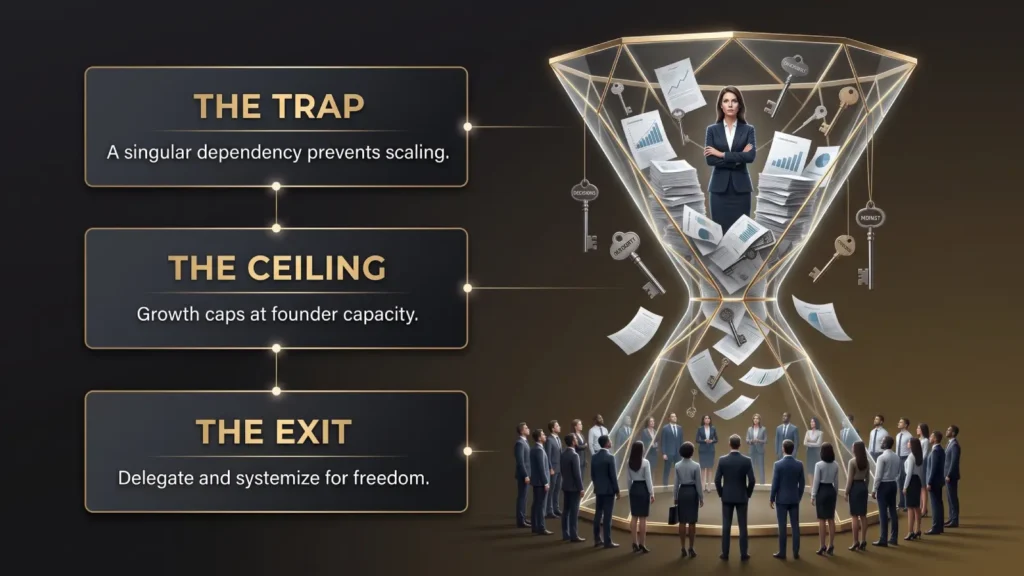
Every founder I talk to says some version of the same thing: “We’re growing, but it feels harder than it should.” Revenue is up. The team is bigger. And yet everything routes through one person — you.
Here’s the uncomfortable truth: the thing that got your business off the ground is often the same thing that’s now capping how far it can go. You are the bottleneck. Not because you’re doing anything wrong, but because the company never stopped depending on you to make it work.
The Pattern I See in Every Growing Company
When a business is small, founder-dependency is a feature, not a bug. You’re close to every customer, every decision, every fire. That’s how you got to where you are.
But somewhere between 10 and 50 people — sometimes earlier — that same closeness turns into a ceiling. Growth doesn’t stall because the market dried up or the team stopped trying. It stalls because nothing moves without you.
Growth Feels Chaotic, Not Broken
This is the part that confuses most founders. Nothing is technically “broken.” Sales are still closing. Product still ships. But every week feels more reactive than the last, and you can’t point to a single thing that’s failing — it’s just… harder to run.
You’re Still the Approval Layer
Look at how many decisions in your business still need your sign-off. Hiring. Pricing. Vendor contracts. Even small operational calls. If the honest answer is “most of them,” that’s not a team problem. That’s a structure problem — and it’s the clearest sign the business is still built around one person instead of one system.
Why This Happens (It’s Not a Character Flaw)
Founders don’t become bottlenecks because they’re controlling or bad at delegating. It happens because of two very ordinary things.
You Built the Company Around Yourself
In the early days, you were the org chart. There was no other option. Every process, every relationship, every piece of institutional knowledge lived in your head because there was no one else to put it in. That worked — until the company outgrew the version of itself that only you could run.
Nobody Told You When to Let Go
There’s no natural alarm that goes off telling a founder “it’s time to stop being the center of everything.” Most founders only notice the bottleneck once it’s already costing them — missed deadlines, slower decisions, a team that’s technically bigger but somehow moving slower than before.
The Cost of Staying the Bottleneck
This isn’t just a personal energy problem. Left alone, founder-dependency shows up as real, measurable damage to the business:
- Slower decisions. Everything waits in a queue that only you can clear.
- Weaker hires. Good people leave when they can’t actually own anything.
- Inconsistent execution. Without you in the room, standards drift.
- A ceiling on valuation. Buyers and investors price in founder-dependency as risk — a business that can’t run without you is worth less than one that can.
What Removing the Bottleneck Actually Looks Like
The fix isn’t working more hours or hiring faster. It’s building the structure that lets the business run without routing everything through you.
Structure Before Headcount
More people without more structure just means more chaos, faster. The businesses that scale cleanly build decision rights, systems, and ownership before they add headcount — not after things break.
Decisions That Don’t Require You
The real test of whether you’ve removed the bottleneck: can your team make a good decision without checking with you first? If the honest answer is no, that’s exactly where the work needs to start.
The Fix Isn’t More Hours — It’s Structure
This is precisely the gap that a fractional COO or operating advisor exists to close. Not to take over your business, but to build the operating structure — the systems, the decision rights, the accountability — that lets it run without you carrying every piece of it personally.
If this pattern sounds familiar, it’s worth a conversation about where the bottleneck actually is in your business today. See how I work with founders on this, or book a short call to talk through what’s specific to your situation.
Where to Start
Removing yourself as the bottleneck isn’t a single fix — it’s a sequence: clarity on what’s actually broken, structure to replace founder-dependency, then scale that holds. That’s the exact framework I use with clients, and I’ll be breaking it down in the next post.
For now, the first step is simple: notice how many decisions this week needed you personally. That number is your real starting point.